
Start with evidence, not a parts list
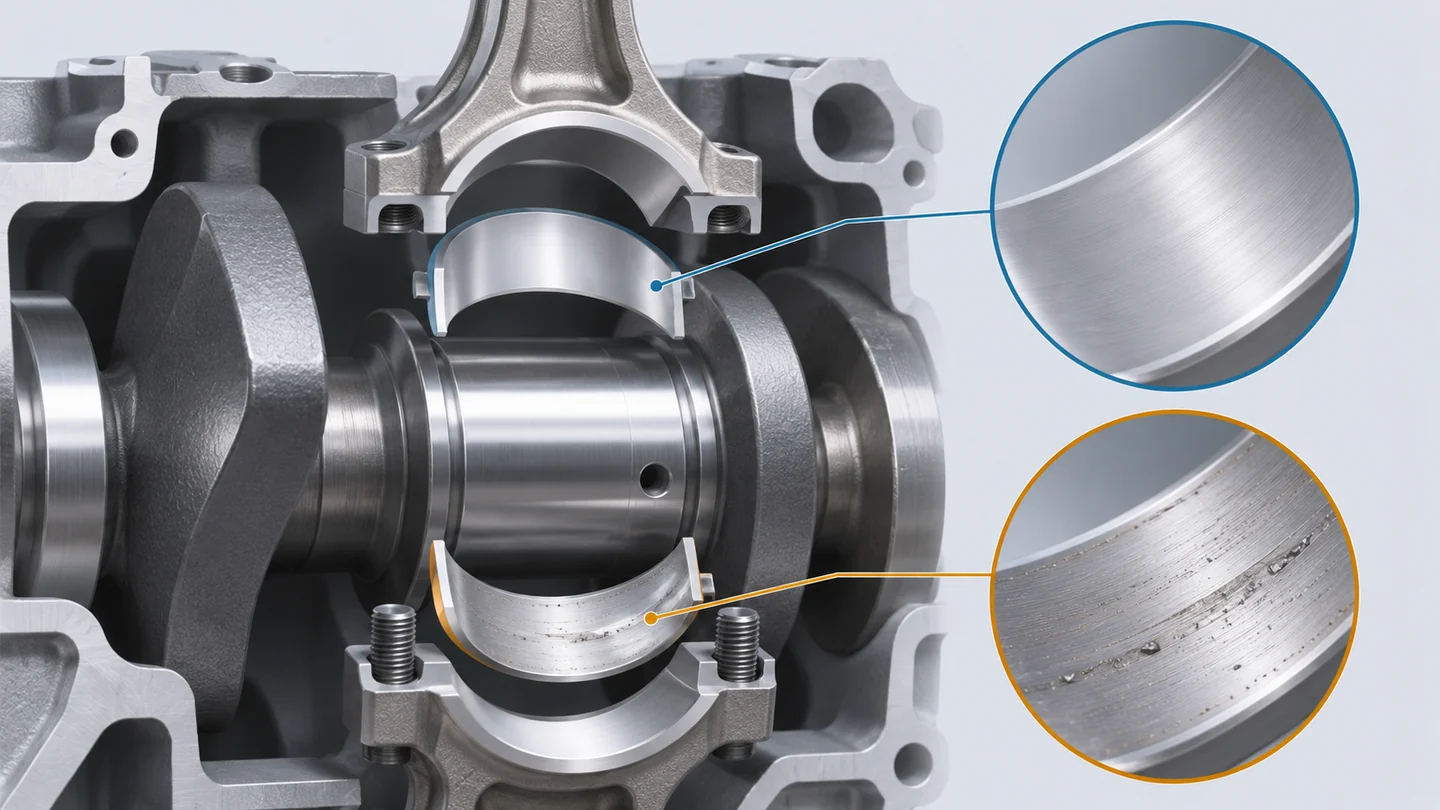
When a workshop reports crankshaft bearing damage, ask what has been observed and what still needs checking. Comparing the bearing shell, shaft journal, related components and any available oil sample can help establish the origin before replacement. The useful starting point is an explanation of those findings. Ask the specialist to distinguish the visible damage from the suspected cause, then explain how that distinction informs the proposed extent of the repair.
Why the oil film matters
During normal running, a continuous film of clean oil separates the shaft journal from the plain bearing. Breakdown of that film or excessive loading can damage the bearing. This explains why lubrication and loading belong in the assessment, but it does not establish what happened in a particular engine. Ask which findings support the specialist’s explanation and where uncertainty remains. A general description of bearing failure should not be presented as a diagnosis of your engine.
A groove is a finding, not a verdict
Hard particles that do not become fully embedded in the bearing can score the shaft journal. However, scoring can also have other mechanisms, so a groove alone does not identify the cause. If scoring is reported, ask how the shell and journal findings compare, and what related evidence has been considered. The explanation should connect the observed marks to a reasoned assessment without treating their appearance as proof of one particular failure mechanism.
Consider where particles could have come from
Oil can carry particles from another damaged engine component. Residue left after work is another possible source. Neither possibility establishes what happened in your engine, and neither justifies blaming a previous repair without supporting evidence. Ask whether the specialist has found evidence of an origin elsewhere, or whether contamination remains a possibility under investigation. Keep the discussion focused on what the assessment supports rather than turning a possible explanation into an assumed history.
Ask what supports the proposed repair
The proposed scope should be explained through the comparison of the bearing shell, journal, related components and any available oil sample. Ask the workshop to describe how those findings support each part of its recommendation, including any proposed work beyond bearing replacement. If the assessment is incomplete, request a clear account of the outstanding checks and the decisions they are intended to inform. That gives you a concrete basis for discussing the estimate without assuming the outcome.
Keep the decision tied to the findings
Before agreeing to the proposed work, ask for a concise account of the observed damage, the suspected origin and any unresolved questions. Where an oil sample is available, ask how it contributes to the comparison with the physical components. The practical aim is an understandable repair recommendation whose reasoning you can follow. Treat a confident explanation as something that needs supporting findings, and ask for clarification wherever the recommendation goes further than the evidence described.