
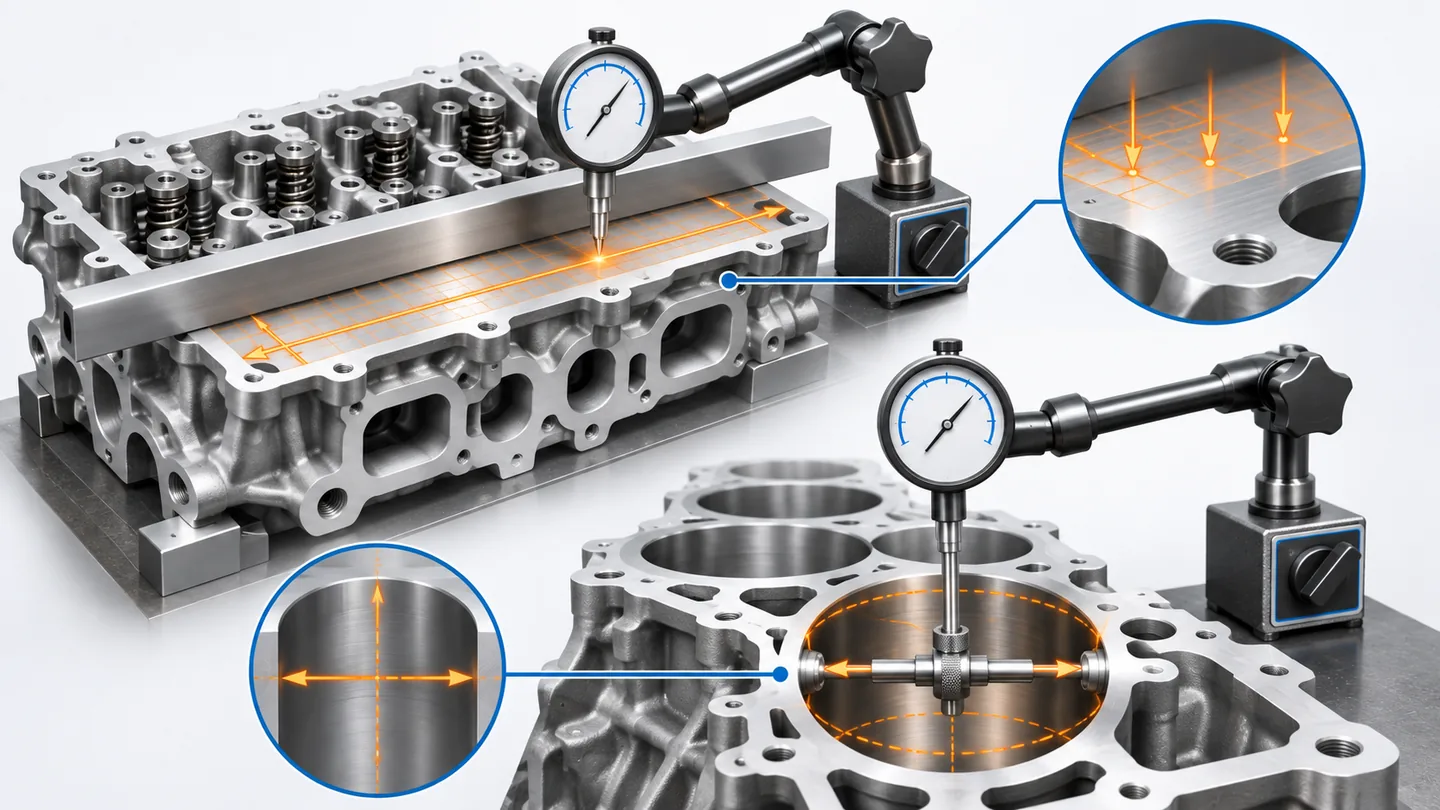
If a report recommends machining a head or block, ask which measurement supports it. Flatness, surface finish and cylinder geometry describe different features. Each matters for a different reason when the engine goes back together.
Flatness and finish where the gasket seals
Flatness describes how far the face departs from a plane. Surface finish describes much finer irregularities on that same face. The gasket seals against both the head and the block. A face can be flat enough and still have the wrong finish for the gasket involved. Cracks and internal leaks need a separate assessment. Fel-Pro on mating surfaces and gasket sealing.
What bore measurements tell you
One diameter at one point cannot show the full condition of a bore. Measurements at different heights and in different directions help reveal whether it tapers or has gone out of round. Surface finish matters for the rings as well. Boring and honing serve different purposes, and what is possible depends on the block design and material. Motorservice on assessing honing results.
What will be left after machining?
The workshop needs to consider how much material can be removed and whether the resulting part will suit the rest of the assembly. There is little value in making a head face flat if doing so takes the part outside its specification. For a bore, ask which pistons and rings would be used afterwards. The limits are specific to the engine. Motorservice on reconditioning aluminium engine blocks.
When looking at a proposal, ask which measurement justified the work, what it was compared with and what will be checked afterwards. If you have a part to discuss, see cylinder head work, engine block work or component machining.